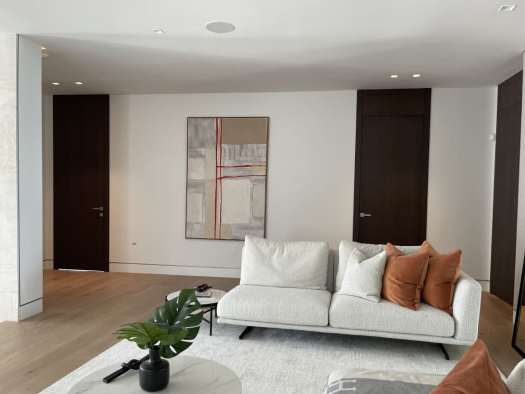

- Modern interior doors in Texas homes
- Why heat and light should guide door selection
- Flush doors for clean contemporary Texas interiors
- Slim Shaker doors for modern farmhouse and transitional homes
- Glass doors for light without losing separation
- Pocket and sliding doors for open spaces
- Best door styles by Texas home type
- Materials that perform well in Texas conditions
- Door colors that work with Texas heat and light
- Hardware choices for modern Texas interiors
- Matching door style to room function
- Modern doors for Hill Country and ranch interiors
- Modern doors for Houston, Dallas, Austin and coastal homes
- Common mistakes when choosing interior doors in Texas
- Expert buying checklist for Texas homeowners
- Final thoughts on modern interior doors in Texas
Modern interior doors in Texas homes
Modern interior doors in Texas should be selected with more precision than many homeowners expect. Texas interiors deal with heat, strong daylight, large open-plan rooms, regional humidity differences, high ceilings, ranch-inspired layouts, Hill Country materials, modern farmhouse trends and a growing preference for indoor-outdoor living. In this setting, an interior door is not only a decorative surface. It controls privacy, light, airflow, visual rhythm and the way large spaces can be divided without losing openness.
The state’s climate creates the first design constraint. The Texas climate is generally characterized by hot summers and mild to cool winters, while the Gulf of Mexico is a major moisture source, especially for the eastern part of the state. Texas also varies significantly by region, with more arid conditions in the west and more humid conditions in the east and along the Gulf Coast.
That regional variety matters for door selection. A contemporary home in Austin, a coastal property near Galveston, a ranch-style home outside San Antonio, a new build in Dallas, a Hill Country residence near Fredericksburg and a suburban family home in Houston do not all need the same interior door package. Some homes need better light sharing. Some need humidity-aware materials. Some need doors that visually calm a large open floor plan. Some need warmth to balance stone, glass and high ceilings.
From an expert perspective, the best modern interior doors in Texas are the styles that make homes feel cooler, brighter and more flexible without looking temporary or overly trend-driven. Flush doors, slim Shaker doors, glass doors, pocket doors, tall slab doors, natural wood veneer and clean panel profiles are usually the strongest options. The key is matching the door to the room, the climate zone and the architectural character of the home.
Why heat and light should guide door selection
Texas homeowners often think about heat in terms of roofing, windows, HVAC and insulation, but interior finishes also shape comfort and perception. Doors influence how rooms are divided, how conditioned air moves, how daylight reaches secondary spaces and how visually heavy or light an interior feels. In a hot state, heavy visual design can make a home feel more closed in than it needs to.
Strong natural light is a major asset in many Texas homes, but it also requires control. Large windows, bright exposures, pale flooring and open layouts can create interiors that feel spacious during the day but flat or overexposed if every surface is white and every door is plain. A modern door can soften that effect by adding wood tone, subtle panel depth, textured glass or a muted painted finish.
Open layouts create another challenge. Many Texas homes use connected kitchen, dining and living zones. This is practical for family life and entertaining, but it can make privacy, noise control and room identity harder. Interior doors can solve this when they are used as flexible dividers rather than fixed barriers.
In Texas, a modern interior door should not simply close a room. It should help manage heat, filter light and give open spaces the option to become private when life requires it.
This is why glass, pocket, sliding and double-door systems deserve special attention in Texas renovations. Used correctly, they preserve openness while giving homeowners control. Used carelessly, they can reduce privacy, weaken acoustics or make the interior look like a collection of trends.
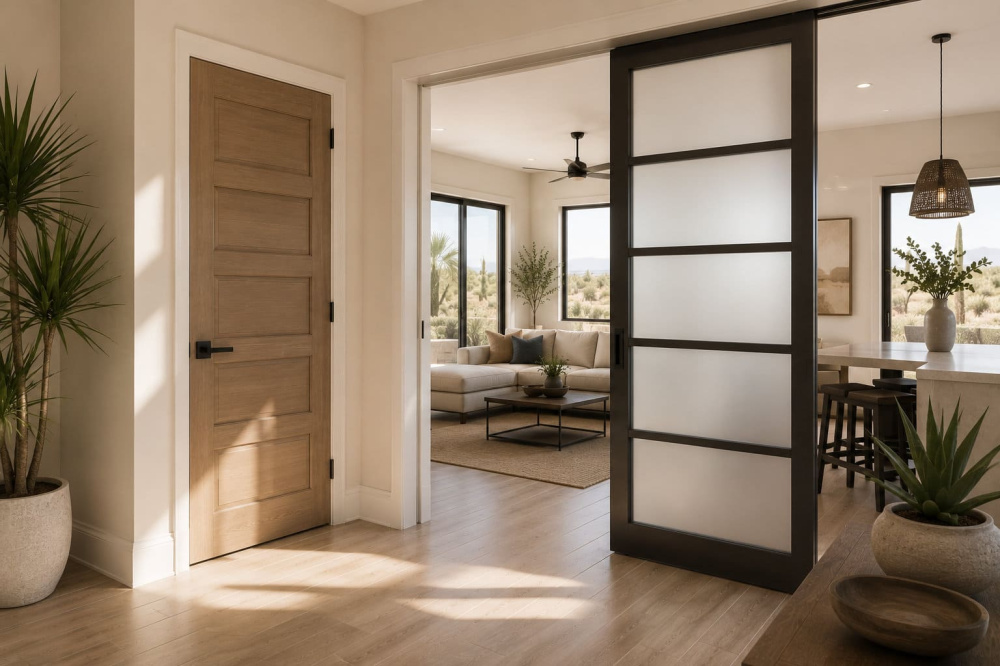
Flush doors for clean contemporary Texas interiors
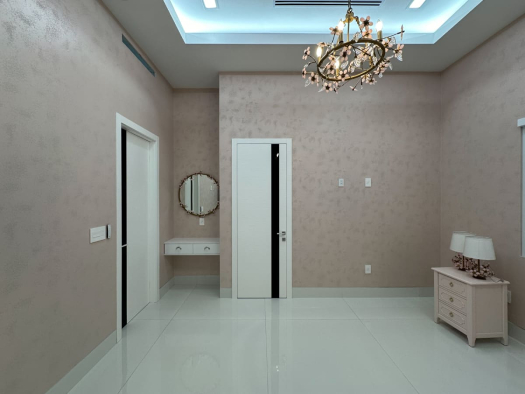
Flush doors are one of the strongest modern choices for Texas homes with minimalist, contemporary or highly architectural interiors. Their flat surface creates a calm wall plane, which is especially useful in open layouts where many doors may be visible from the kitchen, living room or main hallway.
A flush door works best when it is solid-core, precisely installed and paired with refined hardware. A hollow, lightweight flush door can look builder-grade. A solid-core flush door with clean casing, concealed hinges or slim hardware can look quiet and architectural. In modern Texas interiors, quality is what separates simple from cheap.
Flush doors are particularly effective in contemporary Austin homes, Dallas new builds, modern ranch renovations and homes with large windows, stone floors or clean drywall details. They do not compete with views or architectural materials. Instead, they make the interior feel more resolved.
The best finishes for flush doors in Texas are warm white, soft greige, white oak veneer, walnut veneer, charcoal and muted earth tones. Cold white can look too harsh in strong sunlight. Warm neutrals and natural wood usually feel more comfortable in Texas light.
Slim Shaker doors for modern farmhouse and transitional homes
Slim Shaker doors are probably the safest modern choice for a wide range of Texas homes. They are cleaner than traditional raised-panel doors, but warmer and more detailed than flat slabs. This makes them useful in modern farmhouse homes, transitional interiors, suburban renovations, ranch homes and updated traditional houses.
Texas has a strong connection to ranch, farmhouse and regional vernacular architecture. The Texas State Historical Association describes Texas architecture as reflecting a wide variety of cultural influences, physical conditions and technological developments. That diversity is exactly why a flexible door style like slim Shaker works so well. It can adapt to rustic, traditional and contemporary interiors without feeling out of place.
In a modern farmhouse, slim Shaker doors feel more timeless than overused barn-door hardware. In a ranch renovation, they add structure to long hallways and open rooms. In a suburban Texas home, they update builder-grade interiors without demanding a full architectural redesign.
Painted finishes work especially well. Warm white, cream, taupe, greige, olive, clay and charcoal all fit current Texas palettes. Natural wood Shaker doors can also work beautifully in Hill Country homes where stone, beams and warm floors need a door with more material presence.
Glass doors for light without losing separation
Glass interior doors are one of the best solutions for Texas homes because they support light flow while still defining rooms. This is especially useful in open-plan homes where homeowners want visual connection, but also need privacy for offices, dining rooms, dens or media spaces.
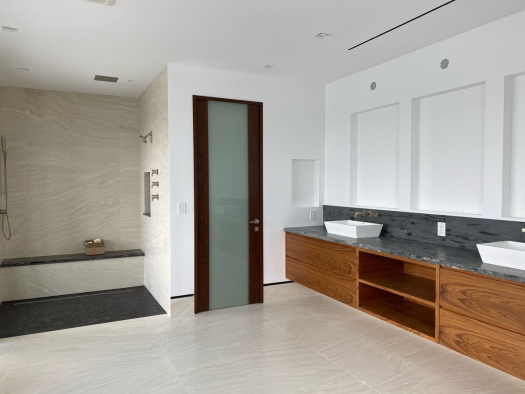
Clear glass works well between public spaces, such as a dining room and living area, or between a sitting room and hallway. Frosted glass is better for home offices, guest suites and areas that need privacy. Fluted or reeded glass is often the most sophisticated option because it filters the view, softens strong light and adds texture without making the door look heavy.
Glass doors are also valuable in homes with deep floor plans. In large Texas houses, interior rooms can feel darker if they are far from exterior windows. A glass door can borrow light from adjacent rooms and make the plan feel more breathable.
The caution is acoustic privacy. A glass door is not always the best option for bedrooms, nurseries or rooms where sound control matters most. In those cases, a solid-core door usually performs better. Glass should be chosen for light and visual connection, not as a universal solution for every room.
Pocket and sliding doors for open spaces
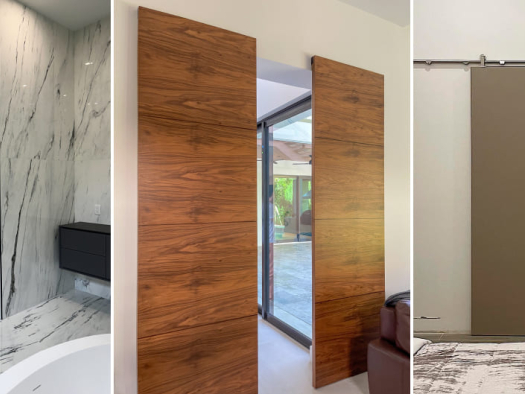
Pocket doors are highly practical in Texas because they help large homes become more flexible and small rooms become more efficient. In bathrooms, laundry rooms, pantries, mudrooms and home offices, a pocket door can save swing space and keep circulation clear.
They are also useful in open-plan homes. A wide pocket door between a kitchen and formal dining room, or between a living room and office, can allow the space to stay open most of the time and become private when needed. This flexibility is more valuable than a permanently open layout.
Recent renovation coverage has also noted that some professionals are cautious about overly open layouts because homeowners increasingly need multifunctional rooms, privacy and adaptability rather than one large undivided space. This trend is highly relevant in Texas, where big kitchens, open living rooms and work-from-home needs often compete inside the same floor plan.
Open-concept living still works in Texas, but the best modern homes now need controlled openness. Pocket, glass and double doors give homeowners options instead of forcing one layout all day.
Surface-mounted sliding doors should be used carefully. Rustic barn doors can work in a pantry, game room, laundry room or casual ranch-style space. They are less convincing for bedrooms and bathrooms because they usually do not seal as tightly as hinged doors. A clean pocket door or modern sliding panel is often a better long-term solution.
Best door styles by Texas home type
Texas has too many regional styles for one universal door recommendation. A Hill Country home may need warmth and texture. A Houston home may need moisture-conscious materials. A Dallas contemporary home may need flush doors and tall slabs. A ranch renovation may need modern simplicity without losing character.
| Texas home type | Best modern interior door styles | Recommended finishes | Expert note |
|---|---|---|---|
| Modern farmhouse | Slim Shaker, two-panel, five-panel, selective barn door | Warm white, greige, olive, natural oak | Avoid making every door look like a trend |
| Hill Country home | Wood veneer, Shaker, glass, refined panel doors | White oak, walnut, clay, cream, bronze hardware | Pair doors with stone, beams and warm materials |
| Contemporary new build | Flush, frameless, tall slab, concealed hinge | Walnut, white oak, charcoal, warm white | Installation quality is critical |
| Ranch-style home | Flush, single-panel, slim Shaker, pocket doors | Greige, soft white, wood veneer, muted black | Use doors to modernize long horizontal plans |
| Coastal Texas home | Moisture-conscious solid-core, frosted glass, painted panel doors | White, sand, pale gray, driftwood, soft blue | Prioritize stable construction and ventilation |
| Suburban family home | Slim Shaker, solid-core panel, frosted glass office doors | White, taupe, warm gray, natural wood | Balance durability with clean design |
| Luxury open-plan home | Tall slab, glass, double doors, veneer doors | Walnut, oak, dark bronze, warm neutrals | Doors should support scale and room hierarchy |
| Finished bonus room or media room | Solid-core flush, acoustic-minded panel doors | Charcoal, deep brown, soft black, walnut | Sound control matters more than glass |
The table should be used as a design guide, not a strict rule. Many Texas homes combine several identities. A ranch house may have contemporary interiors. A farmhouse may have modern glass and steel elements. A Hill Country home may include minimalist details. The best door package connects those layers without making the home feel inconsistent.
Materials that perform well in Texas conditions
Material choice matters in Texas because the state includes hot, humid, dry and mixed conditions. Houston, Galveston and East Texas homes deal with more moisture. West Texas and parts of Central Texas can be drier. Many homes also experience strong air conditioning cycles, which can change indoor humidity.
The EPA recommends keeping indoor humidity between 30 and 50 percent as part of good indoor air quality practice. For doors, this means homeowners should care about stable cores, proper finishing and ventilation in moisture-prone rooms. Bathrooms, laundry rooms, mudrooms and coastal properties need more attention than dry interior hallways.
The best door materials for Texas renovations usually include:
-
Solid-core engineered doors. These are a strong all-around choice for bedrooms, offices, hallways and main living spaces because they feel substantial and provide better sound control than hollow-core doors.
-
MDF doors with quality factory finish. These work well for painted interiors, especially in modern farmhouse, suburban and transitional homes.
-
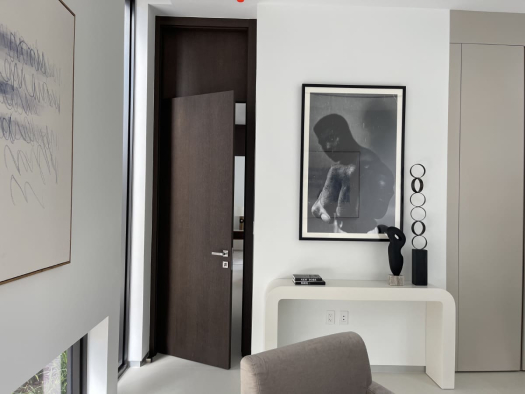
Wood veneer doors. These are excellent for contemporary, Hill Country and luxury interiors when the core is stable and the veneer is properly sealed.
-
Solid wood doors. These can be beautiful in high-end or traditional homes, but they need proper acclimation, finishing and climate control.
-
Moisture-conscious composite options. These can be useful near bathrooms, laundry rooms, coastal homes and utility spaces where moisture exposure is more likely.
The most important detail is edge finishing. A door that is sealed only on the front and back faces is more vulnerable than one finished on all exposed edges. Top and bottom edges matter, especially in rooms with humidity changes.
Door colors that work with Texas heat and light
Texas light can be intense, so door color should be selected with the full interior palette in mind. Bright white may look crisp in photos, but it can feel stark in rooms with strong sun, pale floors and large windows. Warmer whites and muted neutrals usually feel more comfortable.
The best modern door colors for Texas include warm white, ivory, greige, taupe, soft clay, muted olive, charcoal, pale gray, natural white oak and walnut. These tones work with stone, wood, concrete, plaster, tile and large-scale glazing. They also feel less trend-dependent than extreme black-and-white contrast.
Houzz’s 2026 design trend reporting points toward warmer, more character-rich interiors, including detailed millwork, stained woods, earthy hues, muted blues, burgundies and deep browns. This direction fits Texas interiors well because it softens modern spaces and balances bright daylight.
Dark doors can be very effective, but they need discipline. A charcoal door in a home office or media room can look sophisticated. A deep brown or blackened wood door can add drama to a primary suite. But too many dark doors in a hot, bright home can feel heavy if the walls, floors and furnishings do not support the contrast.
Hardware choices for modern Texas interiors
Hardware can change the entire feeling of a modern interior door. A simple slab with poor hardware looks unfinished. A simple slab with a refined lever, clean hinges and a consistent finish can look architectural. In Texas homes, hardware should be durable, comfortable in daily use and visually connected to lighting, plumbing fixtures and cabinet pulls.
Matte black remains popular, especially in modern farmhouse and contemporary homes, but it should not be treated as the default. Satin brass, aged brass, dark bronze, blackened bronze and satin nickel often feel more enduring. In Hill Country and ranch-style homes, bronze and aged brass can relate beautifully to stone, beams and warm wood.
For glass doors, slimmer hardware usually looks better. Heavy hardware can make a glass door feel clumsy. For flush doors, hardware can be slightly more expressive because the slab itself is quiet. For Shaker and panel doors, the hardware should support the profile rather than compete with it.
Concealed hinges can work in contemporary homes, but they are less necessary in farmhouse, ranch and traditional interiors. The goal is not to hide every detail. The goal is to choose hardware that feels intentional.
Matching door style to room function
Every room in a Texas home has a different door requirement. A primary bedroom needs quiet. A home office needs privacy during calls. A pantry needs easy access. A media room needs sound control. A dining room may need separation without losing light.
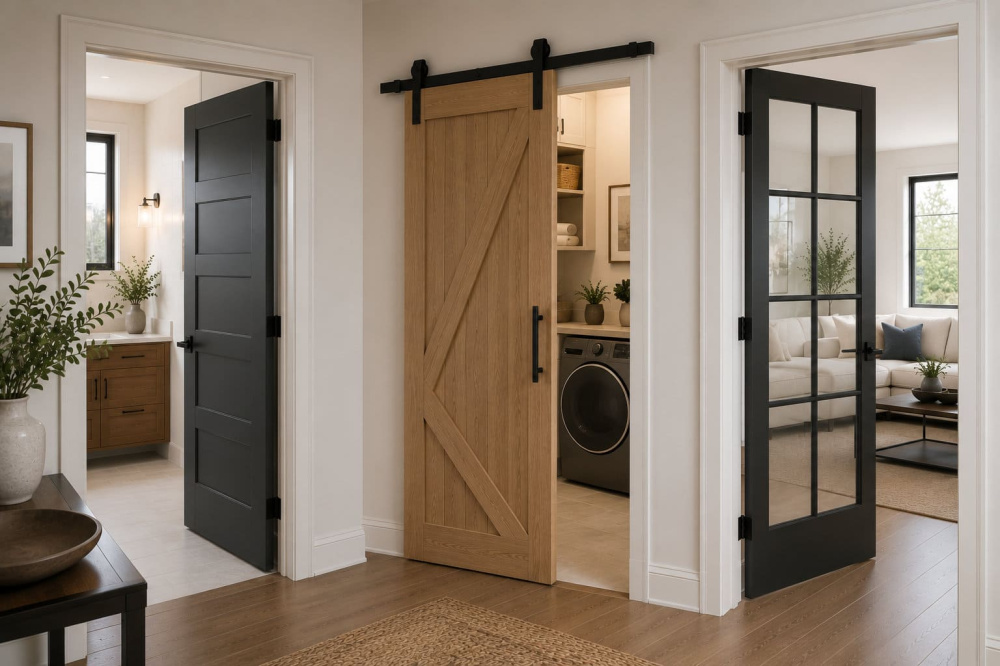
Use this room-by-room approach:
-
Bedrooms should usually use solid-core doors for privacy, weight and sound control.
-
Bathrooms need stable, well-finished doors, proper ventilation and moisture-aware materials.
-
Home offices can use solid-core doors for acoustics or frosted glass doors for borrowed light.
-
Pantries can use Shaker, glass-lite, pocket or sliding doors depending on kitchen layout.
-
Laundry rooms benefit from pocket doors, painted solid-core doors or ventilation-conscious options.
-
Dining rooms can use glass French doors, double doors or slim Shaker doors for flexible separation.
-
Media rooms should prioritize solid-core construction and darker finishes if the design calls for a more enclosed atmosphere.
-
Mudrooms and utility zones should use durable painted or composite options that tolerate heavy use.
This approach keeps the home coordinated without making every door identical. A Texas home can use one main door family and still vary glass, swing type, finish or hardware where function demands it.
Modern doors for Hill Country and ranch interiors
Hill Country homes often combine limestone, timber, metal roofs, deep porches, high ceilings and strong indoor-outdoor relationships. The Texas State Historical Association notes the significant German architectural imprint in the Hill Country and south-central Texas, especially in vernacular dwellings and churches. These homes often look best when modern doors feel substantial, warm and connected to local materials.
White oak veneer, walnut veneer, slim Shaker doors, refined glass doors and bronze hardware are excellent choices for this setting. A frameless white slab may look too thin beside stone and timber. A heavy rustic door may look too old-fashioned. The best solution is usually modern warmth, clean lines with enough material depth.
Ranch-style homes need a different strategy. Many ranch homes have long horizontal layouts, open living areas and practical room organization. Flush doors and slim Shaker doors can modernize these homes without fighting the architecture. Pocket doors are useful in tight baths and laundry zones. Glass doors can help offices and dining rooms feel less closed off.
The key in both Hill Country and ranch interiors is restraint. Texas design often looks strongest when it feels grounded, not overly polished. Materials should have texture, but the profiles should stay disciplined.
Modern doors for Houston, Dallas, Austin and coastal homes
Texas cities have different interior door needs. Houston homes often need special attention to humidity, air conditioning and moisture-prone rooms. Dallas homes often include larger suburban layouts, formal rooms and contemporary renovations. Austin interiors frequently combine modern architecture, natural materials and relaxed indoor-outdoor living. Coastal Texas homes need stable materials, proper finishing and careful ventilation.
Houston homeowners should prioritize solid-core engineered or quality MDF doors for painted interiors, with extra attention to bathrooms, laundry rooms and any areas where moisture may collect. EPA moisture guidance emphasizes controlling liquid water, preventing excessive indoor humidity and selecting moisture-resistant materials for locations that are unavoidably wet.
Dallas renovations can use a wider range of styles, from flush and frameless doors in contemporary homes to slim Shaker doors in transitional interiors. Formal dining rooms, studies and guest suites often benefit from double doors or glass doors that feel more architectural.
Austin homes often suit wood veneer, glass, pocket doors and warm modern finishes. A recent Texas home design feature highlighted the use of organic materials, natural light, warm wood, plaster and metal to prevent a new build from feeling sterile. That design logic applies directly to door selection. In bright modern homes, doors should add warmth and texture, not just disappear.
Coastal homes need the most practical mindset. Painted moisture-conscious doors, frosted glass, sealed edges and stable cores are usually smarter than unfinished natural wood in humid spaces.
Common mistakes when choosing interior doors in Texas
The most common mistake is choosing doors only by style photos. A door that looks perfect online may not work with Texas light, the home’s architecture or the room’s function. Door scale, finish, core type and hardware all matter once the door is installed.
Another mistake is overusing barn doors. They can be attractive in casual Texas interiors, but they are not ideal everywhere. They usually provide weaker privacy and sound separation than hinged solid-core doors. For bedrooms, bathrooms and offices, a standard hinged or pocket door is usually more practical.
A third mistake is choosing too much contrast. Black hardware, black doors, white walls and bright sunlight can look sharp in photos, but in real homes the result may feel harsh. Texas interiors often benefit from warmer contrast, such as bronze with white oak, charcoal with greige or aged brass with cream.
The final mistake is ignoring indoor humidity. Even interior doors can swell, stick or shift if materials are poorly chosen or unfinished. This is especially relevant in coastal areas, bathrooms, laundry rooms and homes with intense cooling cycles.
The best Texas door package is not the one that follows every trend. It is the one that respects heat, light, humidity, architecture and how the family actually lives.
Expert buying checklist for Texas homeowners
Before ordering modern interior doors, Texas homeowners should treat the project as part of the architecture, not just a finish upgrade. The wrong door package can make an expensive renovation feel unfinished. The right one can make the whole home feel more coherent.
Use this checklist before making the final selection:
-
Identify the home style. Decide whether the house is contemporary, ranch, farmhouse, Hill Country, coastal, suburban traditional or transitional.
-
Map the light. Note which rooms need privacy, which rooms need borrowed light and which spaces receive strong sun.
-
Choose the right core. Use solid-core doors for bedrooms, offices, media rooms and main living areas.
-
Plan for humidity. Use stable materials and sealed edges in bathrooms, laundry rooms, coastal homes and utility spaces.
-
Match the trim. Door style and casing should feel like one design system.
-
Confirm swing and clearance. Check furniture, vanities, appliances, closets and hallway movement.
-
Use glass selectively. Choose glass for light and connection, not for rooms that need strong acoustic privacy.
-
Avoid trend overload. Barn doors, black hardware and dramatic contrast should be used with restraint.
-
Coordinate hardware early. Levers, hinges, privacy locks and pulls should match the door’s function.
-
Prioritize installation quality. A modern door only looks modern when gaps, reveals and hardware alignment are precise.
This process helps prevent common renovation mistakes. It also allows homeowners to spend more where doors matter most, such as primary bedrooms, offices, public hallways and main living zones, while using simpler solutions in secondary closets or utility spaces.
Final thoughts on modern interior doors in Texas
Modern Interior Doors in Texas should be chosen through the combined lens of heat, light, open space, humidity and architectural identity. A good door in Texas is not just modern-looking. It helps the home feel cooler, calmer, brighter and more flexible.
Flush doors work best in contemporary interiors. Slim Shaker doors are the strongest all-around option for modern farmhouse, ranch and transitional homes. Glass doors help light move through open plans. Pocket doors make large homes more flexible and small spaces more efficient. Wood veneer adds warmth to bright rooms, while solid-core construction improves privacy and sound control.
The most successful Texas interiors do not overuse one trend. They use different door solutions for different rooms while keeping the whole home visually coordinated. A home office may need frosted glass. A primary bedroom may need a solid-core Shaker door. A pantry may need a pocket door. A Hill Country great room may need warm wood veneer or refined glass.
The best modern door does not fight the Texas environment. It responds to it. It handles heat visually, supports light intelligently, respects humidity and gives open spaces the ability to change throughout the day. That is what makes an interior door feel truly right for a Texas home.