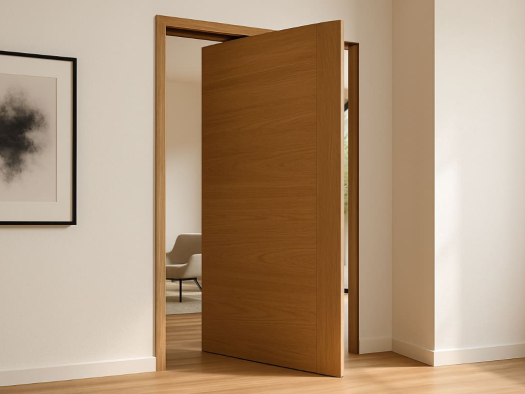

- Modern interior doors in Illinois homes
- Why Illinois needs a practical door strategy
- Slim Shaker doors for Chicago homes and suburbs
- Flush doors for contemporary renovations
- Refined panel doors for traditional Illinois homes
- Glass doors for light in urban and suburban homes
- Pocket and sliding doors for tight layouts
- Best door styles by Illinois home type
- Materials that perform well in Illinois conditions
- Door color and hardware for Illinois interiors
- Matching interior doors to room function
- Chicago homes versus Illinois suburbs
- Common mistakes in Illinois door renovations
- Expert buying checklist for Illinois homeowners
- Final thoughts on modern interior doors in Illinois
Modern interior doors in Illinois homes
Modern interior doors in Illinois should be selected with a wider design lens than color, profile and price. Illinois homes range from Chicago bungalows, two-flats, courtyard apartments and high-rise condos to suburban ranch houses, split-level homes, Colonial-inspired residences, newer open-plan builds and lake-area properties. A door that works in a downtown Chicago condo may feel too flat in a vintage bungalow, while a traditional paneled door that suits an older home can look dated in a modern suburban renovation.
The climate also matters. The Illinois State Climatologist describes the state as having clear regional differences in precipitation and snowfall, with annual precipitation exceeding 48 inches in the south and falling below 32 inches in the north, while snowfall is heavier in northern Illinois and the Chicago area due partly to lake-effect snow from Lake Michigan. State climate summaries also note that annual precipitation varies widely across Illinois, from more than 50 inches in the south to less than 35 inches in the north.
For interior doors, this means homeowners should think about seasonal humidity, dry winter heating, older frames, finished basements, shared walls, compact layouts and the way door materials respond over time. Illinois is not a dry desert market and not a humid coastal market. It is a four-season Midwestern market where doors need to feel stable, substantial and appropriate to the home’s architecture.
From an expert perspective, the strongest modern door styles for Illinois homes are solid-core slim Shaker doors, flush doors, refined panel doors, glass doors, pocket doors and warm wood veneer doors. The goal is not to make every home look like a new-build condo. The goal is to modernize the interior while respecting whether the home is urban, historic, suburban, traditional or contemporary.
Why Illinois needs a practical door strategy
Interior door selection in Illinois is partly a design decision and partly a renovation decision. Many homes, especially in Chicago and older suburbs, have original casing, plaster walls, uneven openings, narrow hallways, small bedrooms and older floor plans. A modern door upgrade can improve the entire home, but only when the door, casing, hardware and room function are considered together.
In Chicago, this is especially important because multi-unit and compact residential buildings are a major part of the housing landscape. The Chicago Architecture Center states that two- and three-flat apartment buildings make up about a quarter of Chicago’s housing. DePaul’s Institute for Housing Studies also reports that two- to four-unit buildings represent 26 percent of Chicago’s housing stock and are especially common in many neighborhoods.
In the suburbs, the challenge is different. Many homes have larger footprints, attached garages, open kitchens, finished basements, split-level circulation and family-centered layouts. Doors need to separate noise, support privacy, improve storage access and help older suburban plans feel more current.
The best Illinois door package should not be selected from a catalog alone. It should respond to the home’s age, climate, trim, layout and the way each room is actually used.
This is why the same home may need several door solutions. Bedrooms may need solid-core doors. Offices may need glass or acoustic privacy. Basements may need moisture-aware materials. Closets may need sliding or bypass systems. Public rooms may benefit from glass or double doors that preserve light while adding separation.
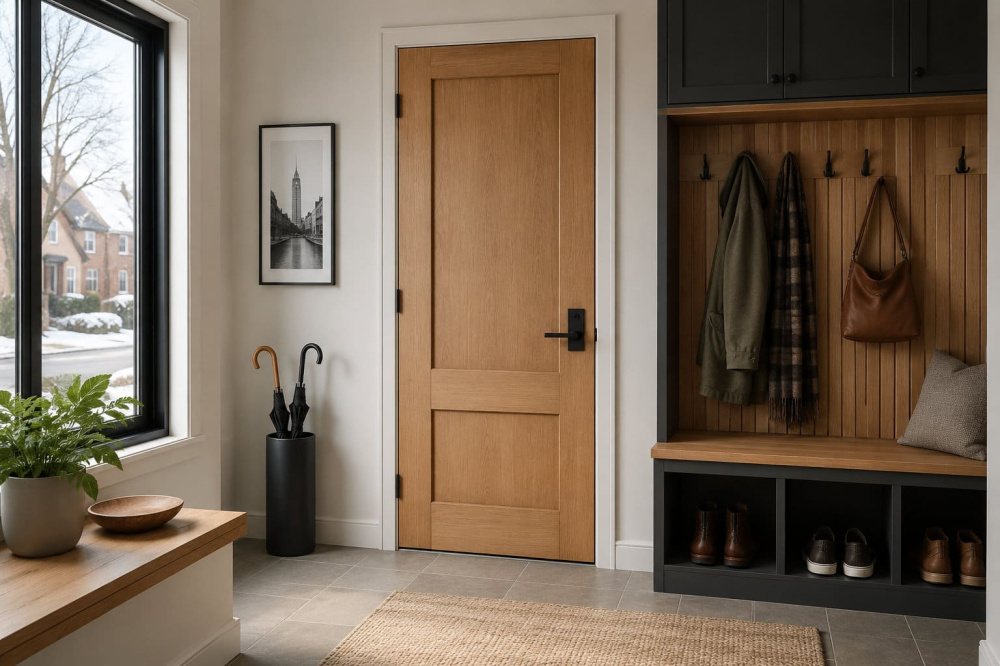
Slim Shaker doors for Chicago homes and suburbs
Slim Shaker doors are probably the most versatile modern interior door style for Illinois. They work in Chicago bungalows, two-flats, vintage apartments, suburban ranch homes, transitional renovations and newer homes that need a cleaner but not sterile look. The Shaker profile gives the door enough detail to relate to traditional trim, but it is simple enough to feel current.
This is especially useful in Chicago bungalows. The Chicago Architecture Center notes that Chicago has more than 80,000 bungalows, making up one-third of the city’s single-family housing stock. The Historic Chicago Bungalow Association describes these homes as brick, one-and-a-half-story houses built from about 1910 to the mid-1930s, commonly with full basements, low-pitched roofs, wide overhangs and Arts and Crafts influence.
A flat slab door can feel too severe in these interiors, especially if the home still has original baseboards, casing, built-ins or hardwood floors. A slim Shaker door is usually a better bridge. It modernizes the room without erasing the architectural warmth.
In suburbs, slim Shaker doors are equally useful. They can update a 1970s split-level, a 1990s Colonial-style home or a newer transitional interior without looking overly trendy. White, warm white, greige, muted blue, olive, taupe and charcoal all work well. For higher-end renovations, a natural wood Shaker door can add warmth without looking rustic.
Flush doors for contemporary renovations
Flush doors work best in Illinois homes with modern interiors, clean casing, open layouts and a more architectural design language. They are especially strong in Chicago high-rise condos, modern townhomes, contemporary suburban builds, renovated ranch homes and finished basements with clean lines.
The key is quality. A flush door looks simple, but that simplicity exposes every weakness. A hollow-core flush door can look thin and builder-grade. A solid-core flush door with precise installation, clean reveals and well-chosen hardware can look refined and intentional.
Flush doors are useful in long hallways because they calm visual noise. This matters in ranch homes, split-level homes and condos where several doors may be visible from one view. When painted the same color as the wall or trim, they can make compact spaces feel less interrupted.
The best finishes for flush doors in Illinois include warm white, soft gray, greige, walnut veneer, white oak veneer and charcoal. Cold white can look harsh in winter light, especially in homes with gray floors or limited natural warmth. Warm neutral finishes usually feel more comfortable across all four seasons.
Refined panel doors for traditional Illinois homes
Not every Illinois renovation needs a minimalist door. Many homes look better with a refined panel door that has proportion, shadow and architectural depth. This is especially true in Colonial-inspired homes, traditional suburban houses, older Chicago residences and formal interiors.
The mistake is choosing panel doors that are too heavy. Deep raised panels, ornate profiles and dated brass hardware can make a renovation feel older than intended. A cleaner two-panel, three-panel or five-panel profile usually works better. These styles preserve traditional character while still looking fresh.
For Chicago bungalows and older two-flats, flat-panel doors often look more authentic than overly decorative doors. For suburban Colonial-style homes, a refined six-panel or slim updated panel door may still work, but the profile should be crisp and the hardware should be current.
Painted finishes are practical. Warm white, ivory, taupe, gray-green and muted blue work well in traditional interiors. Natural wood can also work, especially where the home has original woodwork or stained trim. The important point is consistency. Door style, casing and hardware should look like one decision, not three unrelated updates.
Glass doors for light in urban and suburban homes
Glass interior doors are valuable in Illinois because many homes need borrowed light. Chicago apartments and bungalows can have darker hallways or interior rooms. Suburban homes may have offices, dining rooms or finished basements that need separation without feeling closed off. Glass doors solve this when used carefully.
Clear glass works best between public rooms, such as a living room and dining room, or between a den and a main hallway. Frosted glass works better for home offices, dressing rooms and guest areas where privacy matters. Fluted or reeded glass is often the most sophisticated option because it filters views, softens light and adds texture.
Glass doors are especially useful in work-from-home layouts. A home office may need natural light from a hall or living area, but it also needs visual separation. Frosted or fluted glass can provide a better balance than either a fully open doorway or a completely solid door.
The caution is sound. Glass doors generally do not perform like solid-core wood or engineered doors. For bedrooms, nurseries, media rooms and offices where calls or concentration matter, a solid-core door may be the better choice.
Pocket and sliding doors for tight layouts
Pocket doors are very practical for Illinois homes because they solve a real space problem. Many Chicago homes, older apartments, small bathrooms, laundry rooms and pantry areas were not designed around today’s storage, furniture and work-from-home needs. Removing a swing path can make a room function better immediately.
Pocket doors work well in bathrooms, closets, laundry areas, pantries, offices and finished basements. They are also useful in older homes where homeowners want flexible separation between rooms. In a bungalow or two-flat, a pocket door can feel historically appropriate when the opening and wall conditions allow it.
Surface-mounted sliding doors should be used with restraint. A barn-style door may work for a pantry, laundry room or casual basement, but it is usually not ideal for bedrooms and bathrooms because it does not seal as well as a hinged solid-core door. In a more polished Illinois renovation, a clean pocket door or modern sliding panel usually ages better.
Pocket doors are strongest when they solve a layout problem. They are weakest when they are used only because the hardware looks fashionable.
The wall cavity matters. Plumbing, wiring, studs and structural conditions can limit what is possible. In older Chicago and suburban homes, a contractor should evaluate the wall before the door is ordered.
Best door styles by Illinois home type
Illinois homes are too varied for one universal door recommendation. A Chicago bungalow, a downtown condo, a Naperville new build, an Evanston vintage home, a Schaumburg split-level and a Peoria ranch all need different door logic.
| Illinois home type | Best modern interior door styles | Recommended finishes | Expert note |
|---|---|---|---|
| Chicago bungalow | Slim Shaker, flat-panel, five-panel, pocket doors | Warm white, stained wood, olive, bronze hardware | Respect Arts and Crafts influence and original trim |
| Chicago two-flat or three-flat | Solid-core Shaker, pocket doors, refined panel doors | Cream, greige, white oak, dark bronze | Balance old layout with modern privacy |
| High-rise condo | Flush, tall slab, frameless, wood veneer | Warm white, charcoal, walnut, white oak | Use premium hardware and clean reveals |
| Vintage apartment | Slim Shaker, refined panel, glass French-style doors | Off-white, muted blue, taupe, natural wood | Avoid doors that clash with historic casing |
| Suburban ranch | Flush, single-panel, slim Shaker, glass office doors | Greige, warm white, walnut, soft black | Use doors to modernize long hallways |
| Split-level home | Flush, Shaker, pocket, frosted glass | Soft gray, warm white, oak veneer | Improve flow between staggered zones |
| Colonial-style suburb home | Refined panel, slim Shaker, French doors | Ivory, white, brass, satin nickel | Keep symmetry and classic proportions |
| Finished basement | Solid-core flush, MDF, composite-friendly, pocket doors | White, gray, charcoal, wood-look finishes | Prioritize moisture control and durability |
Split-level homes are especially relevant in many American suburbs. Architectural Digest describes the split-level as a single-family home with staggered floors connected by short staircases, popular in the mid-20th century and still common in American neighborhoods. Ranch-style homes are also important in suburban contexts, with their single-story or L-shaped layouts, large windows and casual open living patterns.
The best door package should connect these home types to modern life without pretending they are all the same. Some homes need warmth. Some need simplicity. Some need space-saving systems. Some need historic restraint.
Materials that perform well in Illinois conditions
Illinois homeowners should pay attention to material stability because homes experience dry winter heating, humid summers, basement moisture and seasonal changes. Wood responds to moisture in the air. Purdue Extension explains that wood shrinks and swells as its moisture content changes in response to daily and seasonal relative humidity, swelling when air is humid and shrinking when air is dry.
This is why solid-core engineered doors are a strong choice for many Illinois renovations. They feel more substantial than hollow-core doors, improve privacy and usually provide better sound control. They are especially useful for bedrooms, offices, bathrooms and main hallways.
MDF doors with a high-quality factory finish are practical for painted interiors. They work well for Shaker, flush and panel styles. Wood veneer doors are a strong choice for modern condos, ranch renovations and higher-end suburban homes because they bring natural warmth while relying on a stable core.
Solid wood doors can be beautiful in historic homes and luxury renovations, but they need proper acclimation and finishing. The top and bottom edges should be sealed, not only the visible faces. This matters in a climate where indoor air can be dry in winter and more humid in summer.
EPA guidance recommends keeping indoor humidity between 30 and 50 percent as part of indoor air quality practice. In Illinois homes, this is especially relevant for finished basements, bathrooms, laundry rooms and older houses where ventilation may be uneven.
Door color and hardware for Illinois interiors
Door color should respond to the home’s architecture and the state’s seasonal light. Illinois interiors can feel bright and green in summer, gray and low-light in winter, and warm in fall. A cold white door may look clean in a showroom but feel stark during winter months. Warm white, ivory, greige, taupe, muted blue, olive, charcoal, walnut and white oak are usually more forgiving.
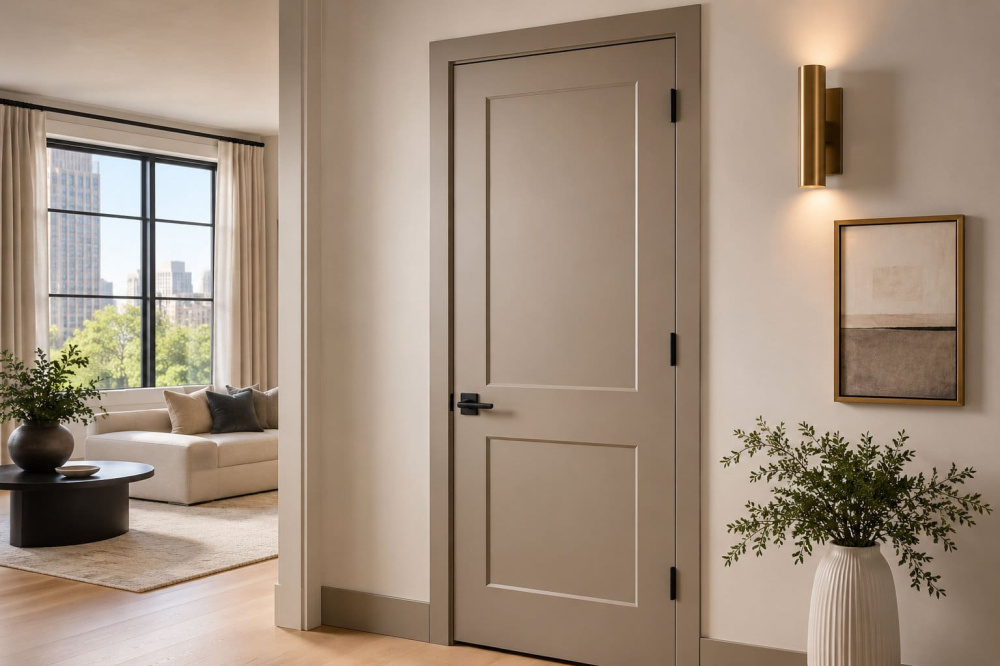
Current design trends are also moving toward warmer and more layered interiors. Recent home design reporting for 2026 emphasizes restrained drama, warm tones, layered textures, aged materials and a move away from stark minimalism. That trend fits Illinois well because older homes and suburban renovations often benefit from warmth rather than extreme contrast.
Hardware should not be treated as an afterthought. Satin brass, aged brass, dark bronze, blackened bronze, matte black and satin nickel can all work, but the right finish depends on the home. Brass and bronze often work well in bungalows, traditional homes and warm interiors. Matte black works best in modern condos, lofts and certain farmhouse-inspired spaces, but it should not be overused.
For flush doors, hardware can carry more design weight. For Shaker or panel doors, simpler levers often look better. For glass doors, slimmer hardware usually feels more refined. The goal is not perfect matching across every metal in the home. The goal is coordination.
Matching interior doors to room function
A strong Illinois door plan should be consistent without being repetitive. Every room has a different purpose, and the door should support that purpose. A bedroom needs quiet. A home office needs privacy. A bathroom needs stable materials and a secure close. A pantry needs convenience. A basement needs durability.
Use this room-by-room approach:
-
Bedrooms should usually receive solid-core Shaker, flush or panel doors for privacy and better sound control.
-
Bathrooms need stable painted doors, sealed edges, proper ventilation and privacy hardware.
-
Home offices can use solid-core doors for acoustics or frosted glass doors when borrowed light matters more.
-
Pantries can use Shaker, glass-lite, pocket or sliding doors depending on kitchen layout.
-
Laundry rooms benefit from pocket doors, painted solid-core doors or ventilation-conscious options.
-
Dining rooms can use glass French-style doors, double doors or refined panel doors.
-
Finished basements should prioritize solid construction, moisture-aware materials and practical hardware.
-
Closets can use hinged, bypass, mirrored or pocket systems depending on clearance.
This approach helps homeowners spend intelligently. The most visible and frequently used doors deserve better cores, better hardware and better finishes. Secondary closets can be simpler unless they are part of a main hallway or entry view.
Chicago homes versus Illinois suburbs
Chicago homes and suburban Illinois homes often need different door strategies. In Chicago, the main concerns are usually compact plans, vintage trim, multi-unit privacy, narrow hallways and older openings. In suburbs, the concerns are often open floor plans, finished basements, larger bedroom suites, mudrooms, pantries and family traffic.
For Chicago bungalows and two-flats, I would usually start with solid-core slim Shaker or flat-panel doors. These styles respect older architecture while giving the home a cleaner feel. Pocket doors can be valuable in small baths and pantries. Glass doors can help dark rooms feel more connected.
For downtown condos, flush doors, tall slabs, concealed hinges and wood veneer are stronger choices. The interior is often cleaner and more modern, so the door can be simpler. However, the quality needs to be high because minimalist doors reveal poor installation quickly.
For suburbs, the best door style depends on the house. A ranch renovation may need flush or slim Shaker doors. A Colonial-style home may need refined panel doors. A modern farmhouse may need simple Shaker doors without too much barn hardware. A finished basement may need moisture-aware doors first and decorative style second.
Common mistakes in Illinois door renovations
One common mistake is ignoring the existing trim. Door and casing should be treated as one system. A frameless modern slab inside ornate traditional casing can look confused. A heavy raised-panel door inside clean modern casing can look dated. The door profile should match the architectural language around it.
Another mistake is choosing hollow-core doors for important rooms. Hollow-core doors may reduce cost, but they often feel light, transmit more sound and weaken the perceived quality of a renovation. Bedrooms, offices and bathrooms usually deserve solid-core construction.
A third mistake is using glass everywhere. Glass can brighten dark spaces, but it does not provide the same privacy or sound control as a solid door. Frosted and fluted glass are best used where light is the priority, not where acoustic separation is essential.
A modern Illinois door renovation should feel upgraded, not simply replaced. The difference comes from core quality, installation, hardware and fit with the home’s architecture.
The final mistake is overlooking basement and moisture conditions. Finished basements are common in Illinois homes, but they need careful material choices. A door in a lower level should be durable, stable and appropriate for the humidity conditions in that specific home.
Expert buying checklist for Illinois homeowners
Before ordering modern interior doors, Illinois homeowners should confirm the technical and design details. Door mistakes are expensive because they often involve installation, casing, paint and hardware, not just the slab.
Use this checklist before making the final decision:
-
Identify the home type. Decide whether the home is a Chicago bungalow, two-flat, condo, ranch, split-level, Colonial-style home, townhome or new build.
-
Review existing trim. Choose a door profile that works with casing, baseboards and wall details.
-
Measure every opening. Older Illinois homes may not have perfectly standard or square openings.
-
Choose the right core. Use solid-core doors for bedrooms, offices, bathrooms and high-use rooms.
-
Plan for seasonal movement. Select stable materials and finish all exposed edges.
-
Consider humidity. Pay special attention to bathrooms, laundry rooms and finished basements.
-
Check swing direction. Make sure the door does not block furniture, vanities, closets or circulation.
-
Use glass selectively. Choose it for light sharing, not for rooms needing strong sound privacy.
-
Coordinate hardware early. Hinges, levers, privacy locks and pulls should fit both function and style.
-
Prioritize installation quality. Modern doors only look refined when reveals, gaps and hardware alignment are precise.
This checklist is especially important in renovation projects. A beautiful door can fail visually if the frame is uneven, the casing is wrong or the hardware looks cheap. In older homes, professional measuring is often worth it.
Final thoughts on modern interior doors in Illinois
Modern Interior Doors in Illinois should be selected through the combined lens of architecture, climate, privacy and daily function. Chicago homes and Illinois suburbs have different needs, but the same principle applies: the best door is the one that fits the home rather than forcing a trend into it.
For Chicago bungalows, two-flats and vintage apartments, slim Shaker, flat-panel and refined panel doors usually work best. For high-rise condos and contemporary interiors, flush doors, tall slabs and wood veneer doors make more sense. For suburban ranches and split-level homes, flush doors, Shaker doors, glass office doors and pocket systems can modernize the layout. For finished basements, material stability matters as much as appearance.
The most reliable modern choices are solid-core construction, warm finishes, restrained profiles, glass used with purpose and hardware that feels substantial. These details make the home feel more finished, quieter and more coherent.
A good interior door in Illinois should not feel like a decorative afterthought. It should improve the way the home looks, sounds and functions through every season.