
- Modern interior doors in Arizona homes
- Why dry heat changes the door decision
- Flush doors for desert modern interiors
- Slim Shaker doors for warm modern homes
- Wood veneer doors for desert warmth
- Glass doors for light control and room separation
- Pocket and sliding doors for open desert layouts
- Best door styles by Arizona home type
- Materials that perform well in dry air
- Door colors for desert light
- Hardware choices for modern Arizona interiors
- Matching door style to each room
- Common mistakes in Arizona door projects
- Expert buying checklist for Arizona homeowners
- Final thoughts on modern interior doors in Arizona
Modern interior doors in Arizona homes
Modern interior doors in Arizona should be chosen with the desert in mind. Arizona homes are shaped by dry heat, strong sunlight, seasonal monsoon moisture, open interiors, stucco architecture, natural materials and a long regional relationship with Southwestern, Pueblo Revival, Spanish Colonial, ranch and desert modern design. In this environment, an interior door is not just a visual detail. It affects comfort, privacy, light control, room flow and the way a home responds to harsh sun and dry air.
Arizona’s climate is arid and semi-arid, with average annual precipitation ranging from about 3 inches in Yuma to around 40 inches in the White Mountains of east-central Arizona, according to the Arizona State Climate Office. This matters because a door that performs well in a humid coastal climate may not be the best choice for a desert home. Dry indoor air, intense cooling cycles and large temperature differences between exterior heat and conditioned interiors can all influence how door materials behave.
The Southwest is also hot partly because it is dry. CLIMAS explains that low atmospheric moisture allows more of the sun’s energy to heat the land surface, while less cloud cover and less evaporative cooling intensify the effect. For interior design, this means Arizona homeowners often want doors that make rooms feel cooler, calmer and visually softer. Overly stark white slabs, glossy finishes and heavy contrast can look harsh in intense desert light.
From an expert perspective, the best modern interior doors for Arizona are flush doors, slim Shaker doors, natural wood veneer doors, frosted or fluted glass doors, pocket doors and clean contemporary panel doors. The key is not to chase one trend. The best door should match the home’s architecture, work with desert light and stay stable in dry interior conditions.
Why dry heat changes the door decision
Dry heat affects how interiors feel. A room can be physically cooled by air conditioning but still look visually hot if every surface reflects glare, every finish is cold white and every opening lacks depth. Doors are repeated throughout the home, so their finish, color and profile have a major effect on atmosphere.
In Arizona, homeowners should think about three practical door questions. First, will the material stay stable in dry indoor air? Second, will the finish look comfortable in strong sunlight? Third, does the door help divide open spaces without making the home feel closed off? These questions matter in Phoenix, Scottsdale, Tucson, Mesa, Chandler, Flagstaff, Sedona and smaller desert communities, although the exact climate conditions vary by elevation.
The summer monsoon adds another layer. ASU notes that Arizona is dry for much of the year, but winds shift in late June and early July, bringing moisture that can trigger summer thunderstorms. This does not make most Arizona homes humid in the same way as coastal homes, but it does mean interior materials experience seasonal changes. A door should be stable enough to handle dry conditions most of the year and occasional moisture shifts during monsoon season.
In Arizona, a modern door should not fight the desert. It should soften the light, respect the architecture and stay reliable through dry air, cooling cycles and seasonal moisture changes.
This is why construction quality matters as much as style. A cheap hollow-core door may look acceptable on a product page, but in a bright Arizona hallway it can feel thin and temporary. A solid-core door with a stable core, clean finish and refined hardware will usually feel more appropriate for a desert home renovation.
Flush doors for desert modern interiors
Flush doors are one of the strongest choices for modern Arizona homes. Their flat surface works well with clean stucco walls, open layouts, polished concrete, large windows, stone floors and contemporary desert architecture. They create a quiet wall plane, which is valuable in homes where sunlight, landscape views and material texture already carry the design.
A flush door should not be confused with a cheap slab. In a desert modern home, a flush door needs weight, precision and a high-quality finish. Solid-core construction is especially important because simple design leaves no decorative detail to distract from poor execution. If the door feels hollow, the entire renovation can feel less substantial.
Flush doors work especially well in Scottsdale contemporary homes, Phoenix new builds, Tucson modern renovations and Sedona homes where the landscape is already visually powerful. They can be painted warm white, sand, greige, clay, charcoal or soft taupe. Wood veneer is also excellent, especially in white oak, walnut or rift-cut oak.
The best flush doors in Arizona are not cold or sterile. They should feel calm, matte and grounded. Houzz’s 2026 design predictions point toward warm wood tones, matte finishes and minimalist hardware as a way to keep streamlined design inviting rather than stark. That direction fits Arizona homes particularly well.
Slim Shaker doors for warm modern homes
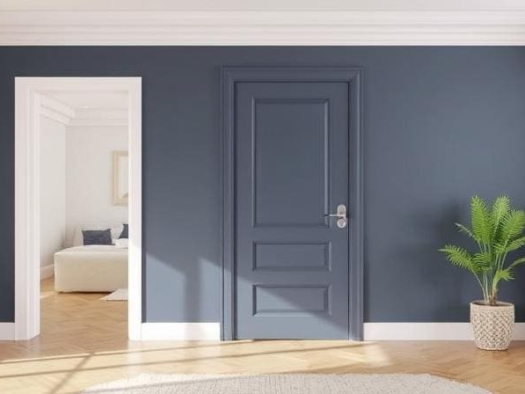
Slim Shaker doors are the most versatile option for Arizona homes that are not fully minimalist. They work in modern farmhouse interiors, transitional homes, updated ranch houses, Spanish-influenced interiors and family homes that need a clean but not overly flat look. The profile gives the door enough depth to hold strong light without looking heavy.
In Arizona, slim Shaker doors are especially useful because they bridge different architectural languages. A home may have stucco walls, arched openings, tile floors, wood beams and modern cabinetry. A flush slab may feel too plain in that setting, while a traditional raised-panel door may feel too formal. A slim Shaker door sits between both extremes.
Color matters. Warm white, cream, greige, desert beige, muted olive, clay and soft charcoal all work well. In a home with Saltillo tile, terracotta flooring or warm stone, a cold gray or pure white door can feel disconnected. A slightly warmer painted finish usually creates a better relationship with the materials.
My expert recommendation is to use slim Shaker doors when the home needs warmth and structure but not ornament. They are modern enough for a renovation and familiar enough to feel natural in Arizona’s mix of ranch, Spanish, Pueblo-inspired and contemporary interiors.
Wood veneer doors for desert warmth
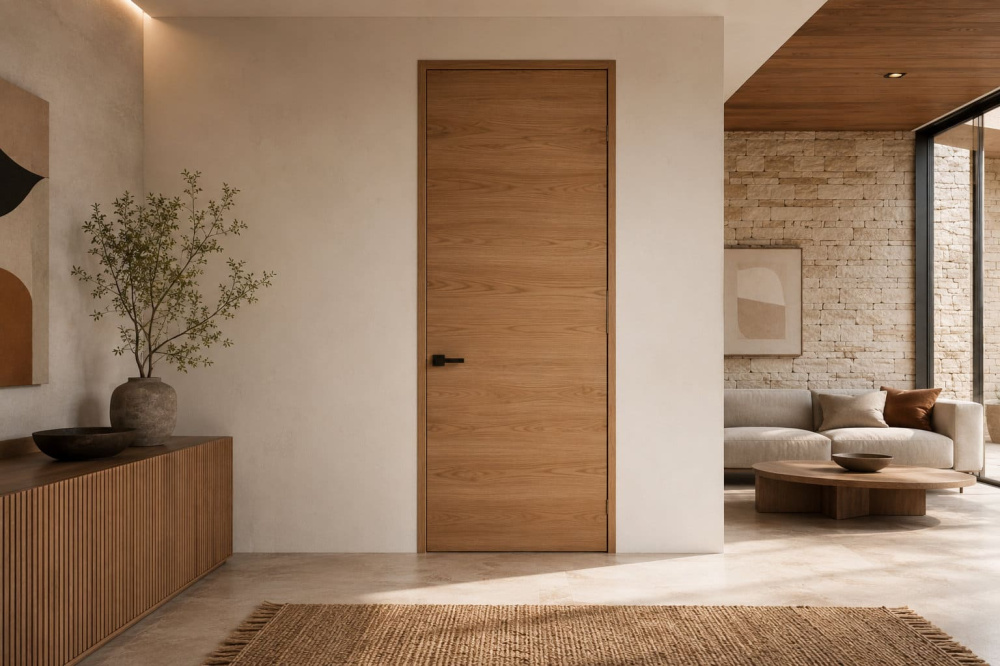
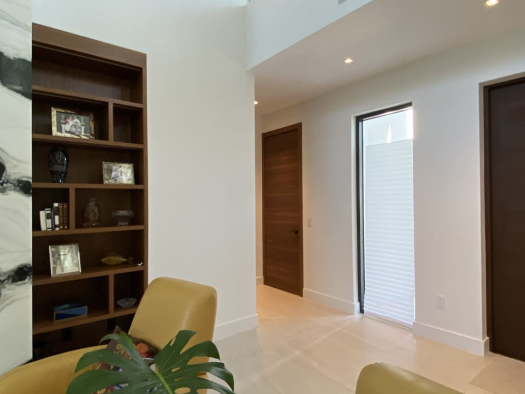
Wood veneer doors can be excellent in Arizona because they bring warmth to interiors that might otherwise feel too bright or hard. Desert homes often include stone, plaster, tile, concrete, glass and metal. Wood gives those materials balance. It also connects the interior to the colors of the landscape, especially when the finish is matte and natural.
White oak is one of the best choices for contemporary desert homes. It feels light, modern and organic. Walnut is richer and more dramatic, making it suitable for primary suites, offices, media rooms and luxury interiors. Rift-cut oak works well when the design needs a precise vertical grain and a calmer visual rhythm.
Wood veneer often makes more sense than solid wood for many modern renovations because it can provide natural appearance with a more stable engineered core. This is important in dry climates, where wood movement can become visible if doors are poorly built, poorly sealed or installed without proper acclimation.
Purdue Extension explains that wood changes moisture content in response to daily and seasonal relative humidity, swelling when the air is humid and shrinking when the air is dry. In Arizona, that means homeowners should pay close attention to core construction, edge sealing and indoor humidity levels, especially in homes with intense air conditioning.
Glass doors for light control and room separation
Glass interior doors can be highly effective in Arizona, but they should be chosen carefully. The state has abundant sunlight, so the question is not simply how to bring in more light. The better question is how to move light without creating glare, heat perception or loss of privacy.
Clear glass works well between public rooms, such as a dining room and living area, or between an entry and a sitting room. Frosted glass is better for offices, guest rooms, dressing areas and interior hallways where privacy matters. Fluted or reeded glass is often the strongest modern choice because it diffuses light, softens views and adds texture without looking heavy.
Glass doors are especially useful in open floor plans. They allow homeowners to create separation for work, reading, dining or guest use while keeping the home visually open. In Arizona, where many homes have indoor-outdoor flow and large gathering spaces, this flexibility is valuable.
The caution is sound. Glass doors usually do not perform like solid-core wood or engineered doors. For bedrooms, nurseries, media rooms and serious work-from-home spaces, a solid-core door is usually better. Glass should be used where light and visual connection matter more than acoustic privacy.
Pocket and sliding doors for open desert layouts
Many Arizona homes have open layouts, wide sightlines and flexible living areas. This works well for casual living, entertaining and indoor-outdoor movement, but it can also create privacy problems. Pocket and sliding doors help homeowners divide spaces only when needed.
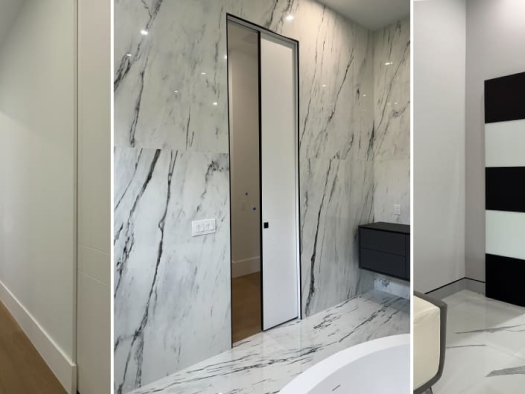
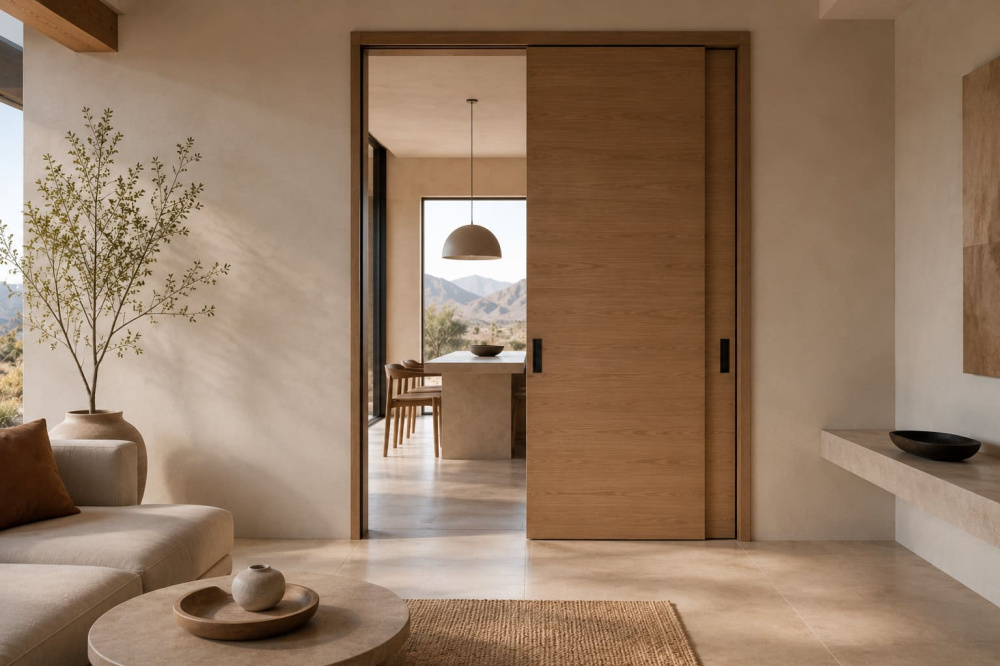
Pocket doors are useful for bathrooms, laundry rooms, pantries, closets, offices and guest suites. They save swing space and make compact areas easier to use. In a modern desert home, a pocket door can also keep the architecture clean because it disappears into the wall when open.
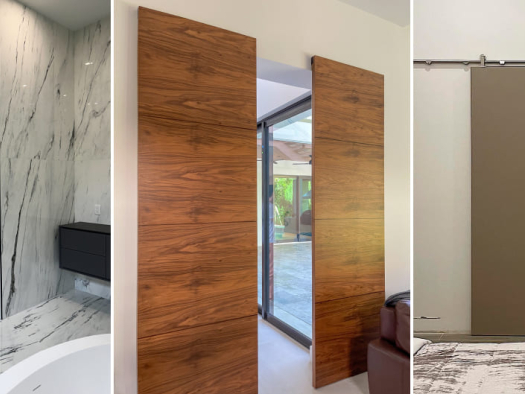
Surface-mounted sliding doors can work, but they should be used with restraint. A rustic barn door may look appropriate in a casual ranch or farmhouse-inspired home, but it is not ideal for every room. It usually provides weaker sound separation than a hinged solid-core door and can feel too trend-driven if repeated throughout the house.
Open space is one of the strengths of Arizona living, but open space still needs control. Pocket, glass and sliding systems allow a home to breathe without giving up privacy.
For larger homes, wide pocket doors or modern double doors can separate a home office, dining room or media room from the main living area. For smaller homes, a pocket door can make a bathroom or laundry area feel noticeably more efficient.
Best door styles by Arizona home type
Arizona has a broad architectural vocabulary, from Pueblo Revival and Spanish Colonial influences to desert modern homes, mid-century ranches, Mediterranean-inspired residences and contemporary luxury builds. Pueblo Revival became a regional Southwestern expression in the early 20th century and drew from Spanish Colonial and Native Pueblo architectural forms. Taliesin West in Scottsdale also remains one of the state’s most important desert modern references, described by the Frank Lloyd Wright Foundation as Wright’s desert laboratory and a National Historic Landmark.
| Arizona home type | Best modern interior door styles | Recommended finishes | Expert note |
|---|---|---|---|
| Desert modern home | Flush, frameless, tall slab, wood veneer | White oak, walnut, sand, charcoal | Keep the door quiet and architectural |
| Pueblo Revival home | Slim Shaker, wood panel, plank-inspired, glass | Clay, cream, natural wood, bronze hardware | Respect texture, thickness and earth tones |
| Spanish Colonial home | Arched panel, refined Shaker, glass French-style doors | Warm white, dark wood, aged brass | Use modern restraint without erasing character |
| Ranch home | Flush, single-panel, slim Shaker, pocket doors | Greige, warm white, oak, soft black | Use doors to update long horizontal layouts |
| Scottsdale luxury home | Tall slab, veneer, concealed hinge, glass doors | Walnut, rift oak, dark bronze, warm neutrals | Scale and hardware quality matter |
| Tucson adobe-inspired home | Wood veneer, Shaker, plank-style, frosted glass | Earth tones, natural oak, clay, cream | Avoid overly glossy finishes |
| Phoenix suburban home | Slim Shaker, solid-core panel, frosted glass office doors | White, taupe, greige, muted olive | Balance durability and modern comfort |
| Sedona or high-desert home | Wood veneer, glass, clean panel doors | Walnut, oak, stone gray, warm white | Let the landscape influence the palette |
The goal is not to copy the exterior style literally inside every room. A Pueblo Revival home does not need rustic doors everywhere. A contemporary home does not need flat white doors in every opening. The best Arizona interiors use door styles that support the architecture while still feeling fresh and livable.
Materials that perform well in dry air
Dry indoor air can be hard on wood-based materials if they are not properly built and finished. In Arizona, doors should be chosen for stability, not just appearance. The most attractive door can become frustrating if it shrinks, cracks, rattles, sticks during seasonal shifts or develops uneven gaps.
The best material choices for Arizona homes usually include:
-
Solid-core engineered doors. These are strong all-around options for bedrooms, offices, hallways and main living spaces because they feel substantial and provide better sound control than hollow-core doors.
-
MDF doors with quality factory finish. These work well for painted Shaker, panel and flush designs when the finish is durable and consistent.
-
Wood veneer doors with engineered cores. These offer natural warmth with better dimensional stability than many solid wood slabs.
-
Solid wood doors. These can be beautiful in custom homes, but they need proper acclimation, sealing and indoor humidity control.
-
Composite or moisture-aware options. These are useful for bathrooms, laundry rooms, utility areas and homes that experience both dry air and seasonal moisture shifts.
The important detail is finishing all exposed edges. The top and bottom of a door matter as much as the faces. If the edges are left raw, the door can absorb or lose moisture unevenly. That is a technical detail, but it directly affects how the door performs.
EPA guidance recommends keeping indoor relative humidity below 60 percent where possible, ideally between 30 and 50 percent. In Arizona, the challenge is often not excess humidity but overly dry indoor air. Still, the same principle applies: stable indoor humidity helps wood-based materials perform better.
Door colors for desert light
Arizona light is powerful, and door color must be selected with that in mind. A color that looks soft in a showroom can look washed out in direct desert sun. A color that looks dramatic online can feel too heavy in a bright hallway. The best Arizona door colors are usually warm, muted and grounded.
Warm white is safer than cold white. Sand, cream, greige, mushroom, taupe, clay, muted olive, charcoal, white oak and walnut all work well. These colors connect naturally to desert landscapes, stucco walls, stone, tile and natural textiles. They also feel more timeless than sharp black-and-white contrast.
Current design reporting continues to favor warmer interiors, natural materials and more character-rich palettes. Houzz’s 2026 trend coverage points to warm woods, natural materials and balanced, approachable spaces. That trend is especially relevant in Arizona because the desert already has strong color, texture and light. The door should add warmth without overwhelming the architecture.
Dark doors can work, but they should be placed carefully. A walnut office door, charcoal media room door or deep bronze pantry door can look sophisticated. Too many dark doors in a bright desert home can make the interior feel visually heavy. The best approach is balance.
Hardware choices for modern Arizona interiors
Hardware is a major part of the door decision. In Arizona homes, hardware should feel solid, tactile and connected to the wider material palette. A beautiful slab can feel unfinished with weak hardware. A simple Shaker door can feel custom with the right lever and hinge finish.
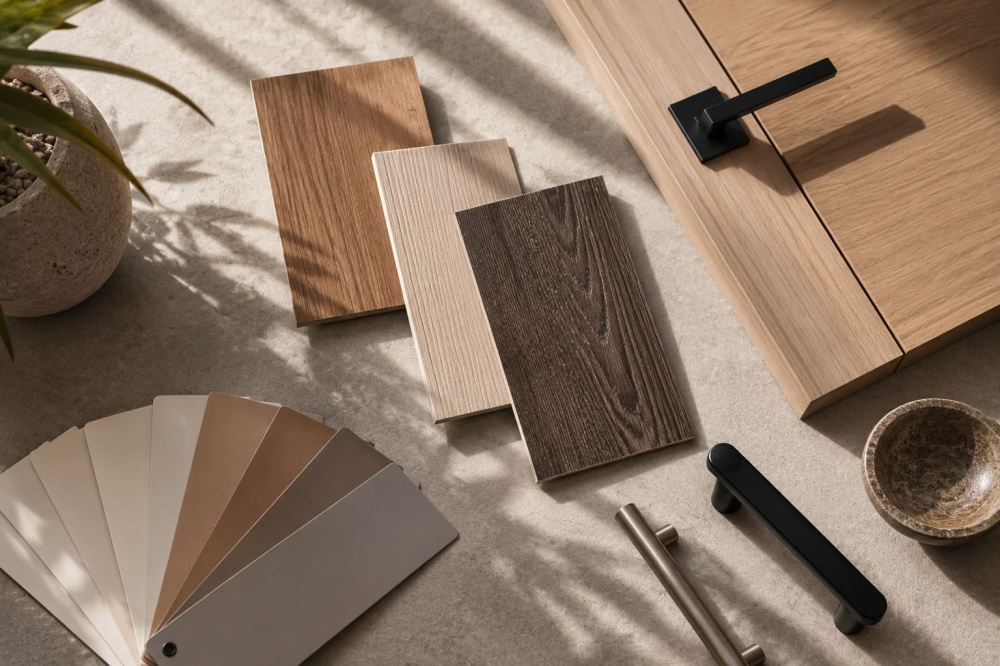
Dark bronze, blackened bronze, satin brass, aged brass, matte black and satin nickel can all work. Bronze and brass often pair especially well with desert materials, including stone, clay tile, plaster, white oak and walnut. Matte black can still work in modern farmhouse and contemporary interiors, but it should not be the automatic choice.
For flush doors, minimalist levers or concealed hinges can create a clean architectural effect. For Pueblo-inspired, Spanish Colonial or ranch homes, visible hardware with warmer character can feel more natural. For glass doors, slim hardware is usually best because heavy hardware can make the door feel bulky.
The key is consistency. Hardware does not need to match every faucet or cabinet pull perfectly, but it should feel intentional. In a desert home, a coordinated mix of warm metal finishes usually looks more natural than a rigid, overly matched hardware plan.
Matching door style to each room
A successful Arizona door package should be coordinated, but not identical everywhere. Different rooms need different levels of privacy, sound control, light sharing and durability. A home office does not need the same door as a pantry. A media room does not need the same door as a guest bath.
Use this room-by-room approach:
-
Bedrooms should usually use solid-core flush, Shaker or panel doors for privacy and a more substantial feel.
-
Bathrooms need stable painted or composite-friendly doors with sealed edges and proper ventilation.
-
Home offices can use solid-core doors for sound control or frosted glass doors when borrowed light is more important.
-
Pantries can use Shaker, glass-lite, pocket or sliding doors depending on kitchen layout.
-
Laundry rooms benefit from pocket doors, painted solid-core doors or ventilation-conscious options.
-
Media rooms should prioritize solid-core construction, darker finishes and secure closing hardware.
-
Guest suites can use warm painted or wood veneer doors to create a more finished hospitality feel.
-
Interior hallways often benefit from consistent flush or slim Shaker doors to reduce visual clutter.
This approach keeps the home functional. It also prevents the common mistake of using one door style everywhere simply because it was available as a package. The best door schedule respects both design and daily life.
Common mistakes in Arizona door projects
One of the biggest mistakes is choosing a door that looks good in a catalog but feels wrong in desert light. Bright white, glossy surfaces and high contrast can look more severe in Arizona than in softer climates. Matte finishes, warm woods and muted colors usually age better.
Another mistake is ignoring dry-air movement. Natural wood and wood-based products need proper acclimation and sealing. Even interior doors can respond to indoor humidity changes. Homeowners should avoid unfinished edges, rushed installation and poor-quality slabs.
A third mistake is overusing rustic design. Arizona homes can support Southwestern and ranch-inspired details, but every door does not need to look heavy, distressed or handmade. Modern desert interiors often look stronger when rustic materials are balanced with clean profiles.
The best Arizona interiors are not generic modern and not overly themed Southwestern. They are grounded, warm and precise.
The final mistake is using glass without considering privacy. Glass can help with light flow, but it is not always the right choice for bedrooms, media rooms or rooms where sound matters. Frosted and fluted glass are useful, but they should solve a specific problem.
Expert buying checklist for Arizona homeowners
Before ordering modern interior doors, Arizona homeowners should evaluate the home as a whole. Door style, core type, finish, hardware, trim and installation all work together. A high-quality slab can still fail visually if the casing is wrong or the hardware feels cheap.
Use this checklist before making the final decision:
-
Identify the architectural style. Decide whether the home is desert modern, Pueblo Revival, Spanish Colonial, ranch, Mediterranean, contemporary or transitional.
-
Study the light. Check how direct sun, reflected light and shaded interiors affect door color during the day.
-
Choose stable construction. Use solid-core engineered, quality MDF, veneer-core or well-made solid wood doors based on the room and budget.
-
Plan for dry air. Confirm acclimation, edge sealing and indoor humidity considerations before installation.
-
Match the trim. Door profile and casing should feel like one design system.
-
Use glass selectively. Choose glass for light sharing, not for rooms that need strong acoustic privacy.
-
Coordinate hardware early. Hinges, levers, pulls and privacy locks should match both function and style.
-
Avoid trend overload. Do not overuse barn doors, black hardware, distressed finishes or high-contrast palettes.
-
Check swing and clearance. Make sure doors do not interfere with furniture, vanities, closets or hallway movement.
-
Prioritize professional installation. Modern doors only look refined when gaps, reveals and hardware alignment are precise.
This checklist is especially important in renovations. Older Arizona homes may have nonstandard openings, settled frames or earlier remodels that changed wall conditions. Measuring carefully before ordering doors prevents expensive mistakes.
Final thoughts on modern interior doors in Arizona
Modern Interior Doors in Arizona should be selected through the combined lens of dry heat, desert light, material stability and regional architecture. A good door in Arizona does more than close a room. It softens brightness, improves privacy, supports cooling comfort and gives the home a more finished architectural rhythm.
Flush doors are excellent for desert modern interiors. Slim Shaker doors are the best all-around choice for warm modern, ranch, transitional and Spanish-influenced homes. Wood veneer doors add natural warmth. Glass doors help move light through open layouts. Pocket doors make rooms more flexible. Solid-core construction improves quality, privacy and sound control.
The most successful Arizona door packages do not force one look into every room. A primary bedroom may need a solid-core Shaker door. A home office may need fluted glass. A pantry may need a pocket door. A desert modern hallway may need flush wood veneer. The home should feel coordinated, but each door should still serve its room.
A modern Arizona interior should not feel cold, glossy or overly themed. It should feel grounded, shaded, tactile and calm. The right interior doors help create that feeling every day.