
- Interior Door Styles for Alabama Homes: From Farmhouse to Contemporary Interiors
- Why Alabama homes need a regional door strategy
- Farmhouse interior doors for Alabama homes
- Craftsman and cottage door styles
- Contemporary door styles for new Alabama interiors
- Best door styles by Alabama home type
- Material choices for Alabama humidity
- Interior doors for open floor plans
- Color and finish ideas for Alabama interiors
- Door style recommendations by room
- Common mistakes when choosing doors in Alabama
- Expert buying and installation checklist
- Final thoughts on interior door styles for Alabama homes
Interior Door Styles for Alabama Homes: From Farmhouse to Contemporary Interiors
Interior door styles for Alabama homes should be chosen with more thought than a simple match to wall color or flooring. Alabama interiors are shaped by Southern architecture, warm weather, humidity, family-centered layouts, porches, open living areas and a wide mix of home types, from classic farmhouses and Craftsman cottages to ranch homes, lake houses and contemporary new builds.
The state’s climate is one of the first practical factors to consider. Alabama is located in a humid subtropical region, with hot summers, mild winters and year-round precipitation, according to the Encyclopedia of Alabama. That means interior doors should not only look good on installation day. They should remain stable, close properly and resist seasonal movement in homes where humidity levels may change through the year.
Style is just as important. Alabama residential design often blends tradition and comfort with modern convenience. Birmingham alone has a broad architectural vocabulary, with the Birmingham Historical Society noting styles such as Bungalow, Cottage, Ranch, Split-Level, Classical Revival, Shotgun, Tudor, Prairie and Craftsman among local examples. This variety explains why one universal interior door style rarely works for every Alabama home.
From an expert perspective, the best interior door is the one that respects the home’s architectural language while improving daily life. A farmhouse needs warmth, texture and honest materials. A contemporary home needs clean lines and restraint. A Craftsman or cottage interior needs proportion and detail. A lake house or coastal Alabama home needs durability, airflow awareness and materials that can handle moisture better than delicate, unfinished wood.
Why Alabama homes need a regional door strategy
Interior doors in Alabama should be selected with regional conditions in mind. Humidity, temperature swings, air conditioning, storm seasons and frequent transitions between indoor and outdoor living all affect how a home performs. Alabama also receives significant rainfall, with the Encyclopedia of Alabama reporting an average annual rainfall of about 55 inches statewide, with higher totals along the Gulf Coast.
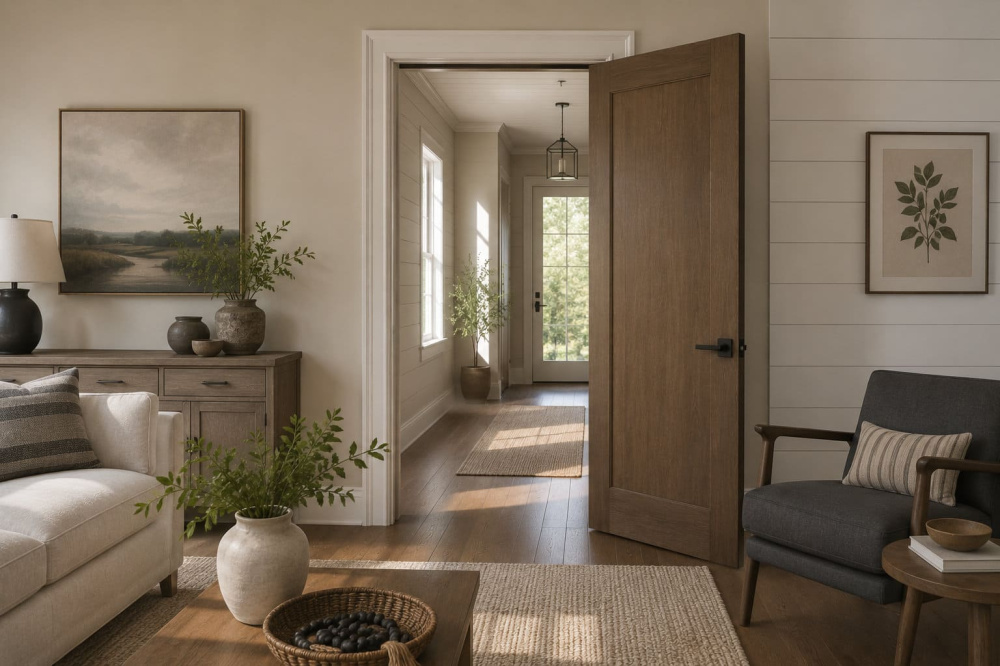
Moisture does not mean homeowners must avoid wood, but it does mean construction quality matters. Solid-core doors, engineered wood cores, proper finishing and well-installed frames are more reliable than cheap hollow-core doors in homes where humidity changes are common. Poorly sealed doors may swell, stick, warp or reveal uneven gaps over time.
A second regional factor is lifestyle. Many Alabama homes are designed around gathering spaces, kitchens, family rooms, guest rooms, mudrooms, porches and flexible bonus areas. Interior doors need to support privacy and separation without making the home feel chopped up or heavy.
The right interior door for an Alabama home should feel natural to the architecture, but it should also perform quietly in the background. It should open smoothly, close cleanly and survive real Southern humidity.
This is why door selection should be handled room by room. A pantry, bedroom, home office, laundry room and formal dining room do not all need the same door. A coordinated door package is better than forcing one style everywhere.
Farmhouse interior doors for Alabama homes
Farmhouse interiors remain especially relevant in Alabama because they connect naturally with rural landscapes, family homes, porches, wood floors, relaxed living and traditional Southern forms. Farmhouse style is rooted in simplicity, function and comfort, while modern farmhouse often adds cleaner lines, lighter palettes and contemporary finishes. Architectural Digest describes farmhouse style as practical and comfortable, with common features such as wood, stone, shiplap, vintage accents and simple materials.
For Alabama farmhouse interiors, the most suitable door styles are not overly ornate. Five-panel doors, two-panel doors, simple Shaker doors and vertical plank-inspired doors usually work better than highly decorative raised-panel designs. They bring enough character without making the room feel heavy or dated.
Modern farmhouse doors should be especially restrained. The style has been overused nationally, particularly when every element becomes white shiplap, black hardware and barn-door hardware. In Alabama, a more refined farmhouse approach feels stronger. Painted wood doors, warm neutral tones, oil-rubbed bronze or aged brass hardware, and simple casing can create a timeless Southern look without looking staged.
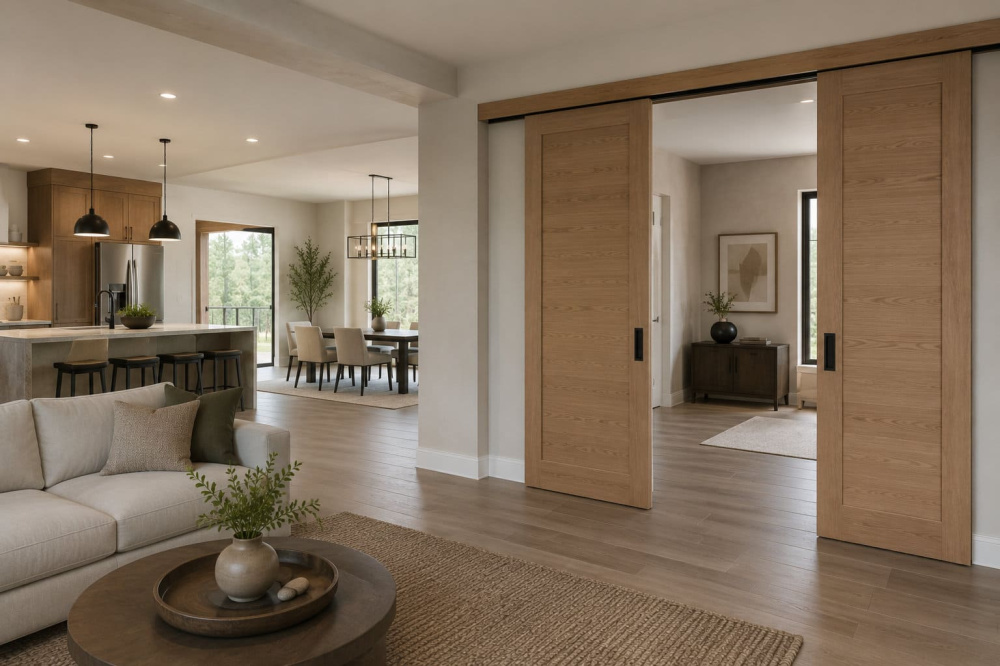
Barn doors should be used selectively. They can work for a pantry, laundry room, craft room or casual bonus space, but they are not ideal for bedrooms or bathrooms where sound privacy matters. A sliding barn door often leaves side gaps and does not seal like a standard hinged door. For a farmhouse bedroom, a solid-core Shaker door is usually the better long-term choice.
Craftsman and cottage door styles
Craftsman and cottage homes are common reference points across Alabama interiors, especially in older neighborhoods, historic districts, smaller towns and renovated family homes. Craftsman architecture is associated with natural materials, visible craftsmanship, functional design and warmth. The Spruce describes Craftsman homes as a reaction against overly ornate Victorian architecture, with an emphasis on woodwork, simple forms and handcrafted character.
For Craftsman interiors, interior doors should have enough detail to feel grounded. Three-panel doors, flat-panel Shaker doors, square sticking profiles and stained wood finishes can work well. The door should look built into the home rather than applied as a decorative surface. In many Alabama Craftsman homes, a too-minimal flush slab can feel out of place.
Cottage homes can accept softer and more charming door profiles. A two-panel arch-top door may work in some traditional interiors, while a simple flat-panel painted door can work in updated cottages. The key is scale. Smaller rooms need doors that feel light, not bulky. Thick moldings and dark finishes can overwhelm a compact cottage bedroom or hallway.
In my view, Craftsman and cottage homes benefit from doors with visible structure. This does not mean heavy ornament. It means the door should have depth, shadow and proportion. Clean Shaker profiles, warm wood and thoughtful hardware are usually more convincing than trend-driven doors that ignore the home’s bones.
Contemporary door styles for new Alabama interiors
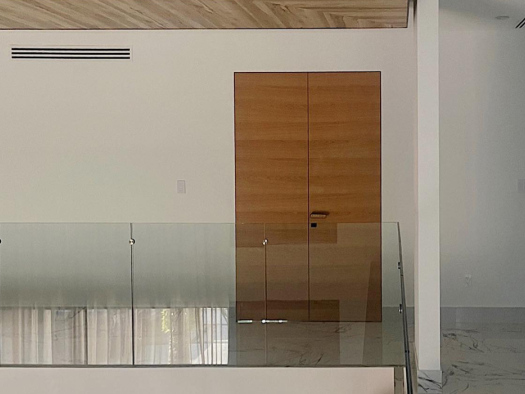
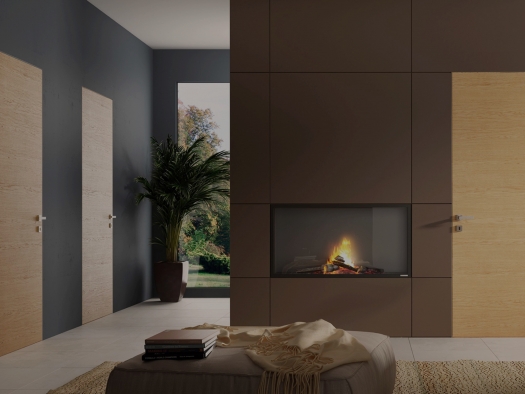
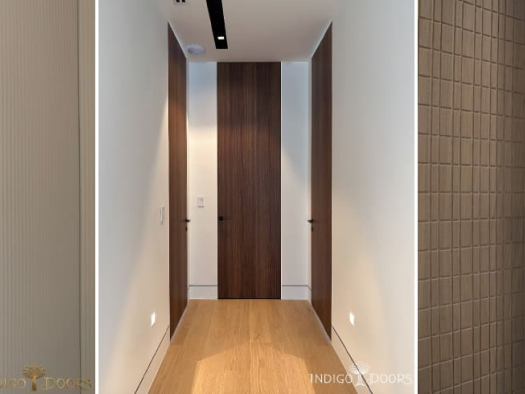
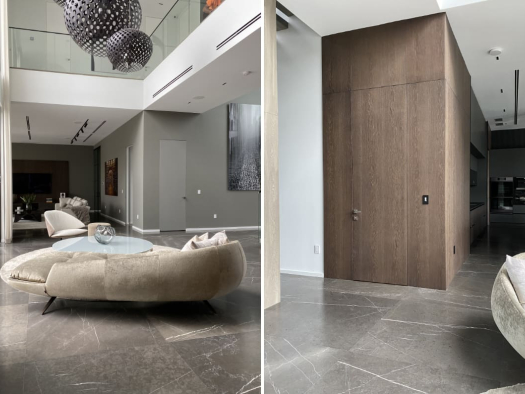
Contemporary Alabama homes often feature open layouts, high ceilings, large windows, neutral palettes, stone surfaces, smooth drywall, built-ins and indoor-outdoor living. In these spaces, interior doors should feel architectural rather than decorative. Flush doors, frameless doors, tall doors, concealed hinges and slim horizontal or vertical profiles are natural choices.
The strongest contemporary doors are usually simple, but not cheap-looking. A flat slab door can look elegant when it is solid-core, well finished and paired with refined hardware. The same door can look builder-grade if it is hollow, thin and surrounded by weak casing. Contemporary design depends heavily on execution.
Houzz’s 2026 trend reporting points toward warmer, more character-rich interiors, including curves, paneling, detailed millwork, stained woods, earthy hues, muted blues, burgundies and deep browns. This matters for contemporary Alabama homes because cold minimalism is less compelling than modern warmth. A contemporary home in Birmingham, Huntsville, Montgomery or Auburn can feel clean without feeling sterile.
For a sophisticated contemporary interior, I would use flush or slim-profile doors in warm white, greige, charcoal, walnut veneer or white oak veneer. Glass doors can also work for offices, dining rooms and media-adjacent spaces, but the glass should be intentional. Frosted or fluted glass is usually more practical than fully clear glass in family homes.
Best door styles by Alabama home type
Different Alabama homes need different door languages. A lake house near Lake Martin, a coastal home near Gulf Shores, a Craftsman bungalow in Birmingham and a modern farmhouse outside Huntsville should not all use the same doors. The goal is consistency within the home, not sameness across every project.
| Alabama home type | Best interior door styles | Recommended finish | Expert note |
|---|---|---|---|
| Modern farmhouse | Two-panel, five-panel, slim Shaker, plank-inspired | Warm white, soft greige, muted green, natural oak | Avoid overusing barn-door hardware |
| Craftsman bungalow | Three-panel, flat-panel Shaker, stained wood | Medium wood stain, cream, olive, warm brown | Door profiles should show craftsmanship |
| Cottage home | Two-panel, simple Shaker, light painted doors | White, ivory, pale blue, soft taupe | Keep profiles lighter in small rooms |
| Ranch home | Flush, single-panel, simple Shaker | White, walnut, gray, black accents | Use doors to modernize long hallways |
| Lake house | Glass, louvered where appropriate, wood veneer, Shaker | White oak, natural wood, soft blue, warm white | Balance privacy with light and airflow |
| Coastal Alabama home | Moisture-aware solid-core, frosted glass, painted panel doors | White, sand, driftwood, pale gray | Prioritize stable construction and ventilation |
| Contemporary new build | Flush, frameless, tall slab, concealed hinge | Walnut, white oak, charcoal, warm white | Quality hardware is critical |
| Traditional Southern home | Raised panel, refined Shaker, French doors | Cream, wood stain, brass hardware | Keep proportions classic and elegant |
This table should be treated as a starting point, not a rigid rule. Many Alabama homes blend styles. A modern farmhouse may have contemporary interiors. A ranch home may be renovated with Craftsman warmth. A lake house may lean rustic, coastal or fully modern.
Material choices for Alabama humidity
Humidity is one of the most important technical considerations for Alabama interiors. Wood naturally responds to moisture, and doors are especially sensitive because they must maintain clearances around the frame. If the slab expands, contracts or twists, the problem becomes visible every time someone opens the door.
EPA guidance on indoor moisture notes that inadequate ventilation can allow indoor moisture to build up and create conditions where mold may grow. While this guidance is broader than doors alone, it reinforces a practical point for Alabama homes: interior materials should be chosen with moisture behavior in mind.
The best door materials for most Alabama homes include:
-
Solid-core engineered doors. These offer better stability and sound control than hollow-core options, making them suitable for bedrooms, offices and main living areas.
-
MDF doors with quality factory finish. These are practical for painted interiors and can be stable when properly manufactured and installed.
-
Wood veneer doors. These work well in contemporary, Craftsman and luxury interiors, especially when the core is engineered and the veneer is properly sealed.
-
Solid wood doors. These can be beautiful, but they need proper acclimation, finishing and installation because natural wood is more responsive to humidity.
-
Moisture-conscious composite options. These can be useful for laundry rooms, bathrooms, coastal properties and utility areas where humidity is higher.
For bathrooms, laundry rooms and coastal homes, I would avoid unfinished or poorly sealed wood doors. Even an attractive door can become frustrating if it starts sticking after one humid season. Proper finishing on all sides, including top and bottom edges, is a detail homeowners often overlook.
Interior doors for open floor plans
Many Alabama homes, especially newer builds and renovated ranch or farmhouse layouts, use open floor plans. These interiors feel spacious, but they also create challenges. Sound travels more easily. Kitchens, living rooms and dining areas visually overlap. Home offices and guest rooms need separation without making the house feel closed off.
Interior doors can help restore control in open layouts. French doors with simplified profiles are excellent for dining rooms, studies and sitting rooms. Frosted glass doors work well for home offices where light is welcome but visual privacy is needed. Pocket doors can divide a kitchen from a pantry, mudroom or laundry zone without taking swing space.
Open-concept living does not eliminate the need for doors. It makes the right doors more important because the home needs flexible privacy, not permanent separation.
The best approach is to use doors as architectural filters. They should let the homeowner decide when a space feels connected and when it feels quiet. This is particularly valuable in family homes where people may be cooking, working, studying and relaxing at the same time.
For Alabama homes with high ceilings, taller doors can make a major difference. An eight-foot door in a main hallway or primary suite can elevate the whole interior. However, taller doors should be used consistently in important zones. Mixing tall and standard doors without a plan can make the interior feel accidental.
Color and finish ideas for Alabama interiors
Color is where Alabama interiors can feel especially personal. Traditional Southern homes often favor warm whites, creams, soft grays, natural wood and polished or aged brass. Farmhouse interiors may lean into ivory, greige, olive, black accents and pale oak. Contemporary homes may use walnut, charcoal, white oak, warm white and muted earth tones.
The best door color should relate to trim, flooring, cabinetry and hardware. A white door with white casing is classic, but it is not the only option. A natural wood door can add warmth to a white interior. A deep green door can make a study feel richer. A charcoal door can give a ranch renovation a sharper modern edge.
For Alabama homes, I would be careful with overly cold whites. In strong Southern light, cold white doors can feel stark, especially beside warm wood floors or creamy walls. Warm white, soft ivory and muted neutral finishes are usually more forgiving.
Hardware should support the door style. Aged brass works well in traditional, farmhouse and cottage interiors. Matte black fits modern farmhouse and some contemporary homes, but it should not be overused. Satin nickel is practical, but it can feel generic if the rest of the home has more warmth. Oil-rubbed bronze remains useful in Craftsman and rustic interiors.
Door style recommendations by room
Every room has a different door requirement. A bedroom needs privacy. A bathroom needs moisture awareness. A pantry needs convenience. A dining room may need beauty more than acoustic performance. Treating all rooms the same is one of the most common door-selection mistakes.
For a balanced Alabama home, use this room-by-room approach:
-
Bedrooms. Choose solid-core Shaker, flush or panel doors for better privacy, weight and sound control.
-
Bathrooms. Use painted solid-core or moisture-conscious doors with proper ventilation and sealed edges.
-
Home offices. Consider solid-core doors for sound control or frosted glass doors if borrowed light matters.
-
Pantries. Use a simple Shaker, glass-lite or pocket door depending on kitchen layout.
-
Laundry rooms. Choose stable painted doors, louvered doors where ventilation is appropriate or pocket doors in tight spaces.
-
Dining rooms. Use simplified French doors, glass doors or refined panel doors to create separation without visual heaviness.
-
Closets. Use simple hinged, bypass or pocket doors based on clearance and storage access.
This kind of door planning produces a home that feels designed rather than assembled. It also keeps the budget focused. Spend more on doors people touch and see every day, such as bedroom doors, office doors and main hallway doors. Use simpler solutions for secondary closets and utility areas.
Common mistakes when choosing doors in Alabama
The biggest mistake is choosing style before performance. A beautiful door that sticks, warps or fails to close properly is not a good investment. In a humid state, door construction, finishing and installation quality are not secondary details.
Another mistake is overusing one trend. Modern farmhouse interiors became popular for a reason, but too much barn hardware, black-and-white contrast and decorative shiplap can make a home feel dated. Recent design coverage has noted a move away from formulaic trend looks and toward more personal, layered interiors with better materials and more individuality.
Homeowners also underestimate hardware. Cheap hinges, weak latches and poorly chosen levers can make even a quality door feel disappointing. Hardware is used every day. It should feel solid in the hand and match the visual weight of the door.
The final mistake is ignoring architecture. A contemporary frameless slab may look excellent in a new build, but it can look wrong in a cottage. A heavy raised-panel door may feel appropriate in a traditional Southern home, but it can look outdated in a modern ranch renovation. Good design depends on context.
Expert buying and installation checklist
Before ordering interior doors, Alabama homeowners should slow down and confirm the practical details. Door replacement becomes more expensive when measurements are wrong, swings are poorly planned or finishes are chosen before flooring and trim are finalized.
Use this checklist before making a final decision:
-
Confirm the home style. Decide whether the interior is farmhouse, Craftsman, cottage, ranch, lake house, traditional or contemporary.
-
Measure every opening. Do not assume all doors are identical, especially in older homes.
-
Check swing direction. Make sure the door does not interfere with furniture, vanities, appliances or hallway movement.
-
Choose the right core. Use solid-core doors where privacy and sound control matter.
-
Plan for humidity. Select stable materials and make sure doors are finished on all exposed edges.
-
Coordinate trim and casing. A modern door can fail visually if the casing belongs to another style.
-
Select hardware early. Hinges, levers, pulls and privacy locks should match the door’s function and design.
-
Acclimate materials when needed. Wood doors should adjust to the home environment before final installation.
-
Prioritize professional installation. Even a quality door performs poorly if the frame is out of square.
-
Keep the door package consistent. Different rooms can have different functions, but the whole home should still feel coordinated.
This checklist is especially useful for renovations, where existing frames may not be perfectly square. Older Alabama homes often have settled walls, uneven floors or nonstandard openings. A skilled installer can correct many of these issues, but only if they are identified before the door is ordered.
Final thoughts on interior door styles for Alabama homes
Interior Door Styles for Alabama Homes should be chosen with a balance of beauty, durability and regional sensitivity. Alabama interiors are too diverse for one universal recommendation. A farmhouse, Craftsman cottage, ranch renovation, lake house and contemporary new build each need a different approach.
For farmhouse homes, simple Shaker, two-panel and five-panel doors usually feel most natural. For Craftsman and cottage interiors, doors should show warmth, proportion and craftsmanship. For contemporary homes, flush doors, tall slabs, concealed hinges and wood veneer can create a cleaner architectural look. For coastal and high-humidity areas, stable construction and proper finishing matter as much as appearance.
The most successful Alabama door packages are not overly trendy. They feel comfortable, durable and connected to the home’s architecture. They consider humidity, room function, hardware, trim and long-term maintenance. Most importantly, they make the home feel more intentional.
A good interior door does not call attention to itself every time someone walks through the room. It quietly supports the style of the house, protects privacy, improves comfort and helps each space work the way it should.